
Ambulance laws in India: what the rules actually say
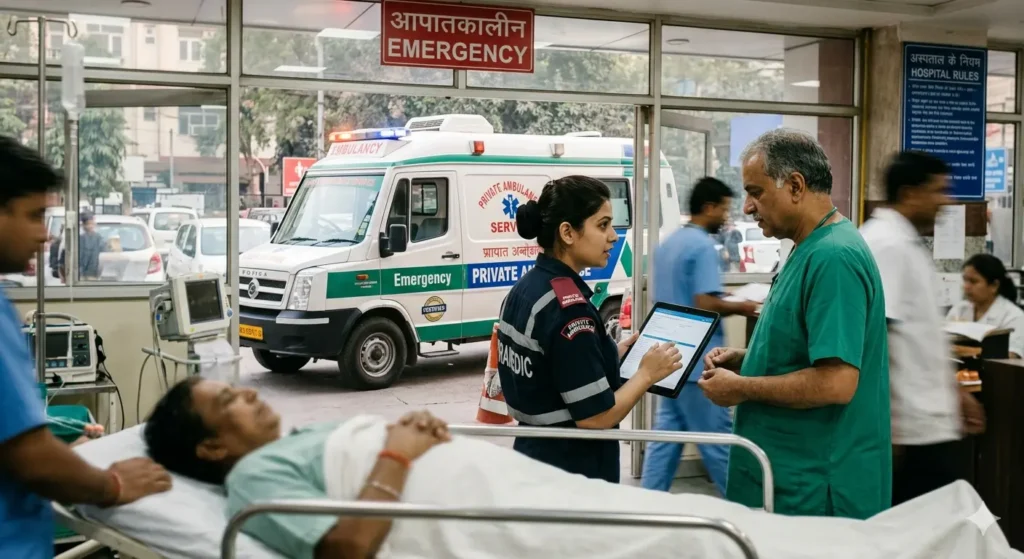
When it comes to saving lives, ambulances are not just vehicles—they’re mobile emergency rooms. But what laws govern these life-saving units? Who can operate them? And what makes a private ambulance legal in India?
This guide demystifies everything about ambulance legality, operations, licensing, driver conduct, and patient rights—backed by Indian laws, Supreme Court directions, and the latest Mandated Equipment:
Type B – Basic Life Support (BLS) Ambulances
Required onboard:
- Oxygen delivery system (cylinders and masks)
- Suction apparatus
- Spine board and stretcher
- Vital-sign monitoring (including ECG)
- First-aid kit and airway tools
Type C – Advanced Life Support (ALS) Ambulances
Includes all BLS items, plus:
- Defibrillator and ECG monitor
- Mechanical ventilator
- Infusion pumps for IV medications
- Stock of emergency drugs (e.g. adrenaline, atropine) as per checklist The Times of India+11vmedo.com+11The Times of India+11
Type D – ICU-Equipped Ambulances
Advanced critical-care vehicles (“ambulance‑on‑wheels”) must carry:
- Full ICU‑grade equipment (ventilators, multi‑channel infusion pumps)
- Onboard a critical care physician and paramedic
Design Rules, 2025 updates.🚑 Vehicle Design & Visual Standards (Central Motor Vehicle Rules & AIS‑125 Conspicuity Code)
Body must be RAL 9010 brilliant white (weather‑resistant finish)
Use red/yellow chevrons or Battenburg striping for conspicuity (RAL 3024 red)
Only medical or emergency-related logos allowed
Commercial branding or operator signs must not exceed 60% size of the “AMBULANCE” marking
Sirens must meet IS 1884 specifications, mounted at the front of the vehicle
Warning lights:
- BLS (Type B) requires flasher lamps
- ALS/ICU (Type C & D) requires flashing multi‑colored (red/blue/white) lights only during emergency response and permitted under Rule 108, AIS‑125
- Blue/red beacon or extra lights are strictly regulated; unauthorized use is banned (e.g. as in Jharkhand HC ruling)
Operational Requirements & Communication
- GPS tracking and real-time fleet monitoring are mandatory, integrated with emergency control centers (like 108)
- 24×7 operational availability, mandatory digital communication link with nearest hospitals, and online/offline services
- Digital patient records and documentation required for transparency and audit compliance
Safety, Hygiene & Interior Standards
- Vehicle interiors must made of shock‑absorbing, washable materials
- Infection control features:
- Segregated clean/contaminated zones
- Antimicrobial surfaces
- PPE storage and biohazard disposal bins
- Fire safety compliance:
- CE‑rated fire extinguishers
- Flame-retardant materials and certified electrical wiring with circuit breakers
Ambulances & the Law: Where Do They Stand?
Under Indian law, ambulances are formally classified as emergency vehicles under the:
Motor Vehicles Act, 1988, and
Central Motor Vehicles Rules (CMVR), 1989
Rule 108 of CMVR allows ambulances to be equipped with multi-colored beacons and sirens.
Rule 27 of Driving Regulations, 2017 gives ambulances the legal right to break signals, exceed speed limits, and bypass traffic rules—but only when responding to emergencies with lights and sirens on.
Blocking an ambulance can now cost you ₹10,000 under Section 194E of the Motor Vehicles (Amendment) Act, 2019.
What Is the National Ambulance Code (AIS-125)?
The Automotive Industry Standard 125 (AIS-125)—also known as the National Ambulance Code—lays down design, safety, and equipment rules for all ambulance types:
Ambulance Types:
| Type | Purpose |
| Type A | Patient Transport Van (non-emergency) |
| Type B | Basic Life Support (BLS) |
| Type C | Advanced Life Support (ALS) |
| Type D | Neonatal care & transport |
Ambulance Drivers & Staff: Who’s Qualified?
Operating an ambulance isn’t like driving a taxi. Only trained, licensed personnel can do the job:
✅ Drivers must hold a Commercial Driving License (CDL) with emergency response training
✅ Paramedics or EMTs (Emergency Medical Technicians) must be certified as per MoHFW or NSDC standards
✅ Ambulance providers must maintain incident logs, digital records, and insurance coverage (motor + medical liability)
Government vs Private Ambulance Services: Key Differences
Ambulance services in India are primarily offered through government-backed schemes and private operators. Understanding the distinction is crucial—especially for patients, healthcare institutions, and entrepreneurs looking to enter the space.
| Feature | Government Ambulances | Private Ambulances |
| Cost to Public | Free under schemes like 108 (emergency) and 102(maternal/child transport) |
Charges vary based on distance, type (BLS/ALS), and city |
| Regulation | Operated under government norms, CMVR, and NHM guidelines | Often loosely regulated unless part of an empanelled system |
| Service Coverage | Urban and rural regions; state-wide integration |
Mostly available in urban centers and metros |
| Complaint Mechanism | State health helplines and centralized redressal | No uniform grievance system; redressal often informal |
| Vehicle Monitoring | GPS and central dispatch mandated | Becoming mandatory (as per 2025 rules), but uneven compliance |
Legal Requirements for Private Ambulance Operators
With rising incidents of overcharging, untrained staff, and operational lapses in the private sector, new legal rules aim to streamline, regulate, and hold private ambulance providers accountable.
Here’s what every private ambulance operator must comply with: Mandatory Registration
Register the ambulance as a commercial transport vehicle with the Regional Transport Office (RTO).
Obtain licenses from the State Health Authority, especially if offering clinical or patient transfer services.
Compliance with AIS-125 (National Ambulance Code)
The ambulance must follow prescribed design standards: color scheme, reverse “AMBULANCE” lettering, Star-of-Life symbol, etc.
Equip the vehicle based on its type (BLS/ALS/Neonatal), including oxygen cylinders, AEDs, suction devices, stretchers, and more.
Fitness Certification & Inspections
Every ambulance must undergo an annual inspection by RTO or authorized agencies.
A valid fitness certificate is mandatory for the vehicle to legally operate. GPS Tracking & Fare Display
All ambulances must be equipped with real-time GPS and panic button systems.
Standardized fare charts must be clearly displayed inside the vehicle. Surge pricing and negotiation at time of an emergency is strictly prohibited.
Ambulance Licensing & Inspection Rule, 2025: What’s New?
Effective across India by September 2025, this new framework modernizes and strengthens compliance for both government and private ambulances:
Key Mandatory Upgrades:
| Feature | Requirement |
| GPS & Panic Button | Real-time tracking and emergency alert button must be installed |
| Sanitation Standards | UV disinfection systems, HEPA air filters, and crash-safe interiors |
| Medical Safety | Biometric drug cabinets to prevent misuse; monitored access |
| Monitoring Systems | CCTV installation mandatory for patient safety and driver conduct |
| Pricing Regulation | Fare must be fixed, published, and invoiced digitally |
| Penalties | Violations attract fines up to ₹5 lakh or license cancellation |
The Good Samaritan Law in India: Legal Protection & Rights Who is a “Good Samaritan”?
A Good Samaritan is any person who voluntarily offers immediate help—without expecting payment or duty—during an emergency such as a road accident or medical crisis. This individual acts in good faith to assist someone in distress.
Why This Law Matters
India faces a high toll of road accident fatalities, with many deaths occurring due to delayed aid. Studies show approximately 50% of these lives could be saved if victims received prompt assistance within the “Golden Hour.” Fear of police harassment, hospital detention, or legal complications often deters bystanders from helping those in need. The Supreme Court and the Ministry of Road Transport & Highways recognized this and acted.
Legal Framework & Protections
Voluntary Help Allowed: Any bystander or eyewitness can transport the injured to the nearest hospital and leave immediately after offering basic details.
No Civil or Criminal Liability: Good Samaritans are exempt from legal actions—even if the outcome is less than ideal—provided they acted in genuine intention.
Identity Disclosure Is Optional: Good Samaritans do not have to reveal personal details either in emergency calls or on hospital registration (including medico-legal forms).
Minimal Legal Burden: If a Good Samaritan also acts as an eyewitness, they will be examined only once, and authorities are encouraged to use video conferencing to reduce inconvenience.
Hospital Obligations:
Must provide first aid without delay, even before payment.
Cannot detain Good Samaritans or demand upfront fees.
Must display, in English, Hindi, and local language, the rights of Good Samaritans prominently.
Official Rules & Legal Status:
The Supreme Court’s 2016 judgement incorporated these protections as binding across India.
Section 134A of the Motor Vehicles (Amendment) Act, 2019 codifies the immunity provisions into law.
The Ministry of Road Transport issued Rules (GSR 594(E)) on 29 September 2020, outlining procedural details including hospitals’ responsibilities and police conduct.
States and local governments are actively promoting Good Samaritan culture:
Prayagraj and Mohali districts have publicized law protections and encouraged citizens to assist accident victims through dedicated road safety committees.
Under the Rah-Veer scheme, Good Samaritans may receive monetary awards (e.g., ₹25,000 in Bihar and Uttar Pradesh) and national recognition until March 2026.
Summary Table: Good Samaritan Rights at a Glance
| Right or Protection | Details |
| No liability | Immune from civil or criminal claims during rescue efforts. |
| Anonymity | Disclosure of identity is completely voluntary. |
| Single-time testing | Only one examination is required if acting as an eyewitness. |
| No hospital charges | First aid must be provided without payment or detention. |
| Mandatory hospital charter | Rights must be displayed in multiple languages. |
Why This Matters
Empowering citizens with legal immunity significantly increases the willingness to act swiftly in emergencies. With hospital compliance, police cooperation, and incentive schemes in place, the Good Samaritan Law aims to save lives—without burdening those who help.
How to Start an Ambulance Service in India: Step-by-Step Legal Guide
Interested in running a legal, compliant ambulance service? Here’s what you must do:
Step 1: Vehicle Registration
Purchase or convert a van to an ambulance as per AIS-125 standards.
Register it as a commercial vehicle with the RTO under the ambulance category.
Step 2: Ensure Design & Equipment Compliance
Install required emergency equipment (based on BLS/ALS type). Follow all design regulations—striping, lettering, sirens, lights. Step 3: Hire Qualified Personnel
Drivers must have a valid Commercial Driving License (CDL).
Employ certified Emergency Medical Technicians (EMTs) or paramedics for ALS ambulances.
Step 4: Register the Facility (if hospital-attached)
If offering services from a clinic or hospital, register under the Clinical Establishments (Registration and Regulation) Act, 2010, where applicable.
Step 5: Technology Setup
Install GPS, panic button, CCTV, and a digital fare and dispatch system. Maintain logs of trips, patient records (with confidentiality), and invoices. Step 6: Insurance & Risk Coverage
Obtain:
Motor insurance
Medical liability insurance
Staff indemnity coverage
Step 7: Annual Renewals & Inspections
Under the 2025 rule, all private ambulances must pass annual fitness tests and random inspections by health/transport authorities.
This article is for general awareness and is not legal advice. Laws change and every matter turns on its facts — please seek independent counsel before acting on it.