IGST and OIDAR in India: a guide for overseas app and SaaS companies
Your app has Indian users. A customer pays for a subscription. The payment reaches you through an app store, Stripe or another checkout provider.
Who accounts for the Indian tax?
The answer is not determined by the payment logo on the checkout page. It depends on what service is supplied, who legally supplies it, where the supplier and customer are located, whether the customer is GST-registered, and what role the platform plays in the transaction.
This guide explains the main Indian rules for overseas digital businesses. It is a starting point for checking your model, not a transaction-specific tax opinion.
What is IGST?
IGST means Integrated Goods and Services Tax. India generally levies it on an inter-State supply. Imported services are treated as inter-State supplies under the Integrated Goods and Services Tax Act, 2017 (IGST Act). The Act also contains special rules for particular cross-border digital services.
For a company outside India, this matters because an online service can have an Indian place of supply even when the company has no office or employees in India. The law can still require tax to be paid in India, either by the overseas supplier or, in some situations, by the Indian business customer under reverse charge.
One useful distinction: GST is the broader issue; IGST is not the label for every Indian GST transaction. A domestic supply classified as intra-State may involve central GST and State or Union Territory GST instead. The supplier location and place of supply must be checked before deciding which tax applies.¹
What does OIDAR mean?
OIDAR is short for Online Information and Database Access or Retrieval services. Under section 2(17) of the IGST Act, it covers services delivered through information technology over the internet or an electronic network where the service cannot be supplied without information technology. The Act gives examples such as cloud services, online advertising, software and digital content, data supplied electronically, and digital data storage.²
That does not mean every service sold through a website is automatically OIDAR. The legal test concerns the service itself and how it is supplied. A SaaS subscription or app service may fit the definition, but the company should examine the actual features, delivery model, contract and human work involved.
There is also an important date point. From 1 October 2023, the words that required OIDAR to be “essentially automated” and involve “minimal human intervention” were removed from the definition. Older explainers may still repeat that wording. Some human involvement, by itself, no longer answers the classification question.³
Why can an Indian user matter if your company is overseas?
For OIDAR services, section 13(12) of the IGST Act places the supply where the recipient is located. The Act includes a test for deciding whether the recipient is in India. Broadly, at least two non-contradictory indicators from the statutory list must point to India. These include the customer’s internet address, payment card, billing address, bank account, SIM country code and fixed-line location.⁴
This is why a company should retain reliable customer-location and transaction records. A country selected in an account profile may not be the only relevant record.
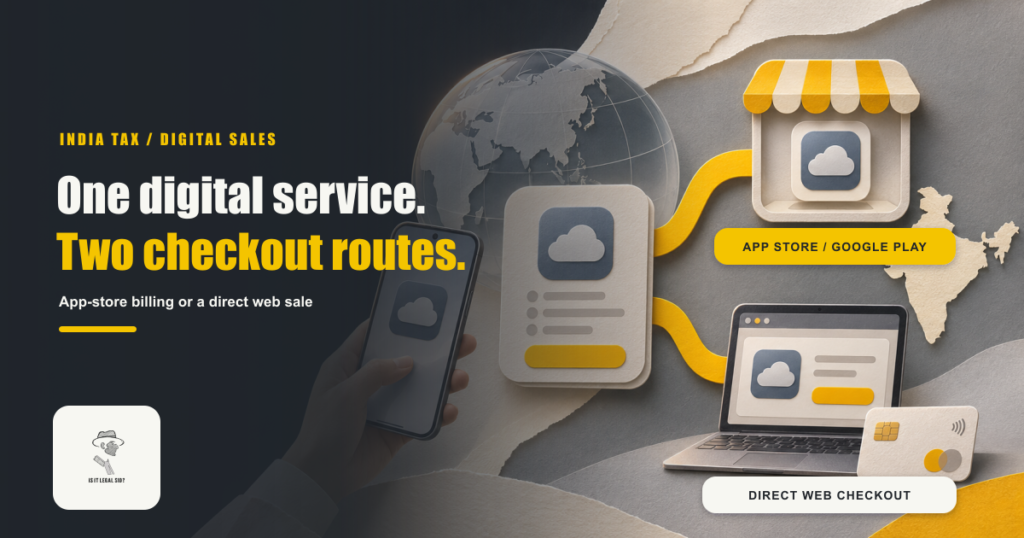
App-store payment and direct web payment are different routes
If the customer buys through Google Play
Google’s published tax guidance says that, for developers located outside India, Google is responsible for determining, charging and remitting GST on Google Play paid-app and in-app purchases made by customers in India. Its guidance also addresses alternative billing, where Google says it will collect applicable taxes from the developer and remit them for the relevant sales processed through that route.⁵
That statement is limited to the transactions described in Google’s policy. It does not mean Google handles tax on a subscription bought on your website, a separate invoice, or every other sale connected to your app.
If the customer buys through Apple’s App Store
Apple’s tax arrangements depend on the applicable agreement, storefront, legal entity, tax category and payment route. Apple describes jurisdictions where it administers transaction taxes, while its developer terms also place tax responsibilities on developers and describe circumstances in which Apple collects or remits tax. Apple separately says developers using alternative payment options are responsible for determining, collecting, remitting and documenting applicable taxes.⁶
So do not assume that an Apple purchase means Apple has taken over every India GST obligation. Check the specific paid-app agreement and transaction report that apply to your account and storefront.
If the customer subscribes on your website and pays through Stripe
Stripe is a payment service. Seeing Stripe on the checkout does not, on its own, establish that Stripe is the supplier of your SaaS or that Stripe will account for Indian GST on your behalf.
For example, a founder in Singapore sells a monthly web-app subscription directly to an individual user in India. The company owns the service, sets the terms, invoices the user and receives the subscription proceeds through a payment processor. If the service is OIDAR and the customer is an unregistered person in India, section 14 may make the overseas supplier liable to pay IGST. The section also contains a specific rule for an intermediary that arranges or facilitates the supply. Whether that rule changes who is treated as supplier depends on the statutory conditions and the actual arrangement.⁷
The founder should therefore map the legal seller, customer category, service, invoice, checkout, terms and money flow. “We use Stripe” is not the end of that review.
When must an Indian business customer pay IGST under reverse charge?
This is a different question from who collects tax from the customer. For certain imported services, an Indian GST-registered business recipient must calculate and pay IGST to the Government under reverse charge. In that situation, the overseas supplier is not simply collecting IGST from the Indian business and forwarding it. Section 14’s special supplier-payment rule concerns a “non-taxable online recipient,” which the Act defines as an unregistered person receiving OIDAR services in India. For a qualifying imported service supplied to an Indian recipient outside that category, Notification No. 10/2017-Integrated Tax (Rate) provides for payment of IGST by the recipient under reverse charge.⁸
In plain language, the registered Indian business may have to report and pay the tax itself. Check the customer’s actual GST registration, the service supplied and the notification conditions. Do not assume every person who calls themselves a business is registered, or that every foreign service falls under the same treatment.
What can happen if the tax is not paid?
The bill can include unpaid tax, interest and a penalty. The figures depend on the tax period and the facts. Interest is charged on the unpaid tax, not calculated as a percentage of the penalty. For delayed IGST, the notified interest rate under section 50(1) is 18% per year. Interest runs for the period the tax remains unpaid, subject to the statutory calculation rules.⁹
For financial years 2024–25 onward, section 74A sets these penalties for a tax shortfall:
- No fraud, wilful misstatement or suppression to evade tax: 10% of the tax due or ₹10,000, whichever is higher.
- Fraud, wilful misstatement or suppression to evade tax: a penalty equal to the tax due, which is 100% of that tax amount.
Earlier payment can change the penalty, if the statutory conditions are met. In a non-fraud case, paying the tax and interest before notice, or within 60 days after the show-cause notice, can conclude the proceedings without a penalty. In a fraud case, the specified penalty is 15% before notice, 25% within 60 days after notice, or 50% within 60 days after the order. These are conditional routes, not automatic discounts. For tax periods up to FY 2023–24, sections 73 and 74 apply instead and have different timelines and payment stages.¹⁰
What could those numbers look like?
Suppose ₹1,00,000 of tax remains unpaid for 365 days. At 18% a year, interest would be about ₹18,000. If a non-fraud section 74A order applies, the penalty is the higher of 10% of ₹1,00,000 (₹10,000) or ₹10,000, so ₹10,000. That makes an illustrative total of about ₹1,28,000: ₹1,00,000 tax, ₹18,000 interest and ₹10,000 penalty.
If the statutory fraud conditions are established, the section 74A penalty is ₹1,00,000, or 100% of the tax in this example. Adding the same illustrative interest gives about ₹2,18,000 in total. The exact interest depends on the actual due date, payment date and calculation rules. These examples do not mean every case attracts the same penalty.
Under section 74A, the highest stated penalty for the tax shortfall is 100% of the tax due in the fraud category. There is no separate rupee cap stated for this percentage penalty. Fraud or suppression must still be established through the statutory process. If your company has already sold digital services to Indian customers, ask a qualified Indian GST adviser to review the sales data, customer status, platform contracts and filing history before deciding what to do.
A quick decision path for founders
Use this as a first-pass screen, not as a final tax calculation:
- What did you sell? Identify the service actually delivered. Check whether it meets the statutory OIDAR definition.
- Where is the customer? Apply the recipient-location rules and retain supporting records.
- Is the customer GST-registered? A registered business customer can lead to a reverse-charge analysis; an unregistered recipient can bring the section 14 OIDAR supplier rule into play.
- Who legally supplied the service? Read the customer terms, invoice, app-store agreement and payment arrangement. Do not decide this from the payment processor’s brand alone.
- Which route processed the sale? Separate Google Play or Apple App Store transactions from website checkouts, alternative billing and other sales.
- What records support your treatment? Keep transaction-level sales reports, customer-location evidence, GSTIN status where relevant, invoices, platform agreements and tax filings together.
| START: Where did the Indian customer pay? | |
| Google Play or Apple App Store | Your website, Stripe or another gateway |
| Check the exact store, billing route, developer agreement and transaction report. Google states that it handles GST for specified Play purchases by overseas developers. Apple treatment depends on the applicable agreement and route. | A payment processor does not automatically become the supplier. Check who contracts with the customer, issues the invoice and sells the service. Also check whether a platform meets the IGST Act intermediary rule. |
| ↓ Next, identify the service, test the OIDAR definition and verify the recipient’s location and GST status ↓ | |
| Unregistered recipient in India + qualifying OIDAR service | GST-registered Indian business + qualifying imported service |
| Section 14 may make the overseas supplier liable for IGST, subject to its intermediary rule and the transaction facts. | Check reverse charge under section 5(3) of the IGST Act and Notification No. 10/2017-Integrated Tax (Rate), including whether the service and recipient meet the conditions. |
| Before filing: reconcile the contract, seller, customer records, invoices, platform agreement and transaction reports. If uncertain, get a transaction-specific GST review. | |
Frequently asked questions
1. Does having Indian users automatically mean my company owes IGST?
No. The user’s location matters, but the answer also depends on the service, place-of-supply rules, supplier, customer’s registration status and any applicable platform or reverse-charge rules.
2. Is every SaaS subscription an OIDAR service?
Not automatically. Apply section 2(17) to the service as actually delivered. SaaS, cloud tools and app services may fit, but the product label alone is not a legal classification.
3. If I use Stripe, does Stripe pay Indian GST for me?
The use of Stripe alone does not answer who is legally liable. Review who supplies the service and whether the arrangement is a payment-processing service or a platform that has a different legal role.
4. Does Google Play handle GST for every sale made by my company?
No. Google’s published India policy describes paid apps and in-app purchases on Google Play, including specific treatment for alternative billing. It does not say it handles all website sales or every transaction outside those categories.
5. What if the Indian customer is GST-registered?
For some imported services, the Indian recipient may have to pay IGST under reverse charge. Confirm the customer’s registration, service classification and the applicable notification before relying on that treatment.
6. What records should we review first?
Start with the customer-facing terms, invoices, sales by country, customer GSTIN records where applicable, app-store or payment-provider agreements, transaction reports, and prior GST registrations and returns.
The question to resolve before your next India sale
Do your checkout records show the same story as your contract?
If the app store, website, invoice and customer terms point to different sellers or payment routes, pause before assuming the tax treatment is settled. Map each route separately, identify the customer type, and review the relevant Indian GST provisions against the actual transaction.
Is It Legal Sid advises technology businesses on practical India-facing legal and compliance questions, including OIDAR and IGST analysis. The right review begins with the transaction documents and sales data, not a guess based on the checkout button.
This article is general information for business education. It is not a tax opinion or legal advice for a particular transaction. The law and tax administration may change. Confirm the current position with a qualified Indian GST professional before acting.
References
- Integrated Goods and Services Tax Act, 2017, §§ 5(1), 7(3)–(4), 8(2), available at India Code.
- Id. § 2(17).
- Finance Act, 2023, No. 8 of 2023, § 160, effective 1 October 2023; IGST Act § 2(17) and accompanying amendment note.
- IGST Act § 13(12).
- Google Play Console Help, “Tax rates and value-added tax (VAT),” India rules for developers located inside and outside India, Google.
- Apple Developer, “Understanding taxes,” including alternative-payment responsibilities and country or region differences, Apple; Apple Developer Program License Agreement, § 5.3 and relevant paid-app terms, Apple.
- IGST Act § 14(1)–(2).
- IGST Act §§ 2(16), 5(3), 14; Notification No. 10/2017-Integrated Tax (Rate), 28 June 2017, entry 1, CBIC.
- Central Goods and Services Tax Act, 2017, §§ 50, 73, 74, 74A, India Code; IGST Act § 20.
- CGST Act § 74A(5), (8)–(12). Section 74A applies to reasons pertaining to FY 2024–25 onward.
- Notification No. 6/2017-Integrated Tax, 28 June 2017, table entry for IGST Act § 20 read with CGST Act § 50(1), 18% per annum, CBIC.
This article is for general awareness and is not legal advice. Laws change and every matter turns on its facts — please seek independent counsel before acting on it.